Letters · Reading Foundation
ABCs: Letters & Sounds
Every letter as a friend with a shape, a name, and a sound. Pure sounds, a reading-first order, stories, chants, daily review, and clear mastery checks.
Pairs well with Wednesday (Mercury day: words, songs, and letters).
Aim
To give the child every letter of the alphabet as a living friend with a shape, a name, and a sound, and to make the sounds so sure, so quick, so automatic, that reading can begin.
Two things are learned here, and they are not the same. The letter's name ("ess") is what we call it. The letter's sound (/sss/) is what it says when it reads. Children who know the sounds can blend them into words. So, following the strongest research on early reading, we teach the sounds first and most, the names alongside, and we teach them in an order that lets the child read real words within the first week.
The Waldorf way gives every letter a story and a picture. The classical way gives it daily recitation, precise practice, and clear mastery. Here they work together: the story makes the letter beloved; the drill makes it permanent.
By age
Littles (3–5): stories, songs, the sound chant, sand-tray tracing, and games. One new sound every few days, or slower. Many Littles learn the sounds happily long before they are ready to blend; let them. Never press.
Young readers (5–6): the full sequence below, four new sounds a week, with daily review and simple blending from week 1.
Olders (7+): the same sequence at a brisker pace (all single sounds in four to five weeks), with dictation, spelling, digraphs, blends, and correct letter formation in print and cursive-ready strokes. Then onward to the full phonogram set.
Materials
- Letter cards: one index card per letter, lowercase large on the front, a small picture mnemonic on the back (you will draw these with the stories)
- A sand or salt tray (a baking sheet with a thin layer of salt works well)
- Beeswax or felt letters, or letters you shape from beeswax or clay
- A small basket of objects for sound sorting (sock, sun, apple, ant, top, pig, pen...)
- Large paper and block crayons for big letters; a main lesson book for Olders
- Two small felt figures or peg dolls for blending games
- A timer for one-minute review (optional)
The Pure Sounds
This is the single most important page in the lesson. Say each sound cleanly, without adding "uh." Not "suh" but /sss/. Not "muh" but /mmm/. Not "tuh" but a crisp, whispered /t/. When the "uh" is added, "c-a-t" becomes "cuh-a-tuh," and blending breaks.
- Stretchy sounds can be held: /sss/ /mmm/ /fff/ /nnn/ /lll/ /rrr/ /vvv/ /zzz/ and every vowel. Teach the child to sing them long.
- Bouncy sounds are short and cannot be held: /t/ /p/ /k/ /b/ /d/ /g/. Say them as briefly and quietly as you can, almost whispered.
- Short vowels first: a as in apple, e as in egg, i as in insect, o as in octopus, u as in up. Long vowel sounds (the letter saying its name) come later.
- c and k both say /k/. x says /ks/. qu is taught together and says /kw/.
Practice the sounds yourself before you teach them. Children copy exactly what they hear.
The Order of Letters
We do not teach A, B, C in alphabet order. We teach the most useful sounds first, in small groups, so that after only six sounds the child can read sat, pin, tap, nap, pit. This order is the one widely used by systematic phonics teachers:
- Group 1: s a t p · words to read: sat, pat, tap, sap, at
- Group 2: i n m d · words to read: pin, tin, man, sit, dim, and
- Group 3: g o c k · words to read: dog, cot, kit, got, cap
- Group 4: ck e u r · words to read: duck, red, sun, rug, kick
- Group 5: h b f l · words to read: hat, bed, fun, leg, bus, fluff
- Group 6: j v w x · words to read: jam, van, wet, box, six
- Group 7: y z qu · words to read: yes, zip, quit, quack, buzz
Then the digraphs (two letters, one sound): sh, ch, th, ng, then ai, ee, oa, oo, ar, or, and the rest of the phonograms, described in the stretch section.
The alphabet order, A to Z, is learned separately, by song and recitation, because the child will need it for dictionaries and lists. Both are memory work; neither waits for the other.
The Daily Routine
Ten to fifteen minutes for Littles, twenty to thirty for Olders. Same shape every day. The sameness is the gift: the child always knows what comes next.
- 1. Opening verse (below), standing.
- 2. Quick review (two minutes): flash every letter card learned so far. The child says the sound. Aim for an instant answer. Put any slow ones in a little 'friends to visit' pile and show them again at the end.
- 3. The new letter's story (Monday of each new letter): tell the story; draw the picture with the letter hidden inside, as in our S: The Swan, M: The Mountain, B: The Bear, and W: The Wave lessons.
- 4. Multisensory practice (the new letter): walk its shape large on the floor; trace it in the air with a straight arm; trace it in the sand tray while saying the sound; shape it in beeswax. See it, say it, hear it, move it.
- 5. Hearing the sound: 'I spy something that begins with /sss/.' Sort the objects basket by first sound.
- 6. Blending (once the first group is known): see below.
- 7. Closing: the letter-sound chant, then put the cards away together.
Picture Stories
Every letter gets a picture in which its shape hides, and a sound the picture makes. Tell a short story; draw the picture large; let the child find the letter inside. Some to begin with:
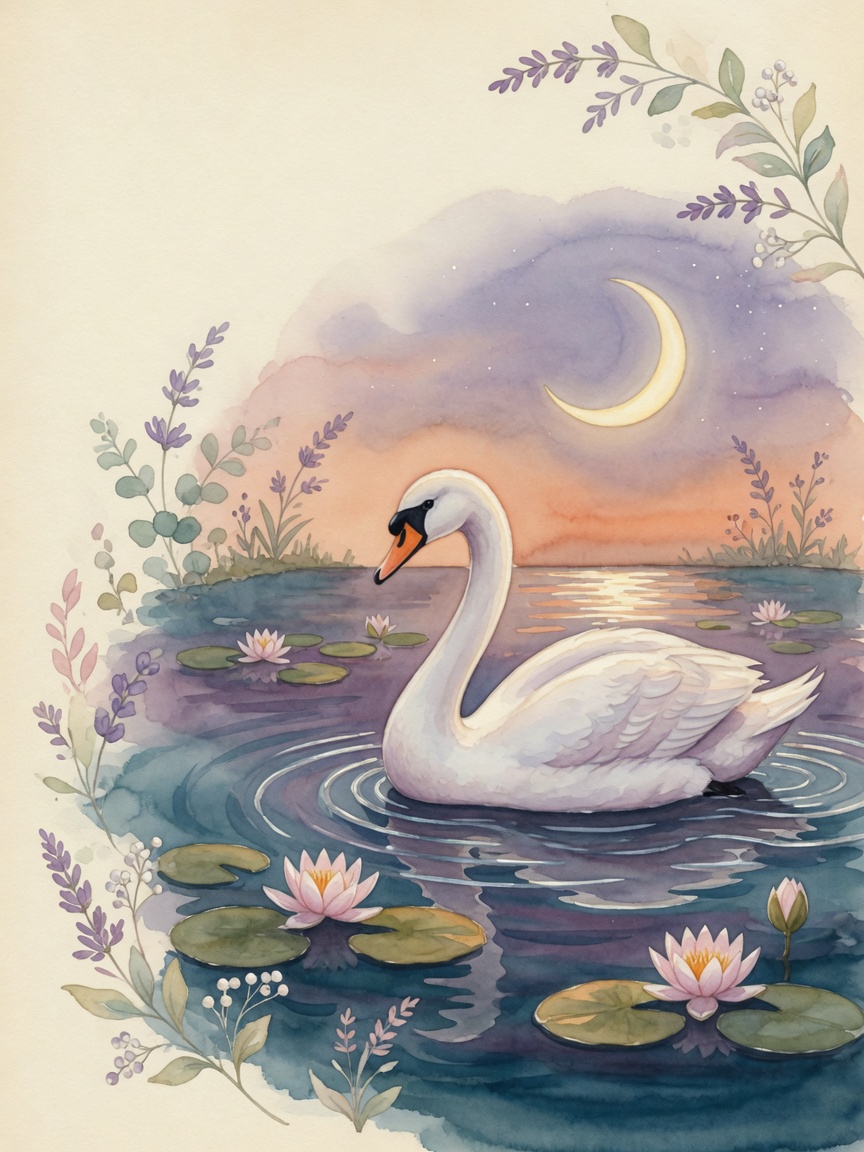
- s: the swan who glides with a long hiss, /sss/, her neck curving into s. (See S: The Swan.)
- a: the little ant climbing round an apple, /a/ /a/ /a/.
- t: the tall tree tapping on the window, /t/ /t/ /t/.
- p: the puff of steam from the pot, /p/ /p/ /p/ (hold a hand before the lips and feel the puff).
- i: the itchy insect with the dot above his head, /i/ /i/ /i/.
- n: the noisy bee buzzing round the n-shaped doorway, nnnnn.
- m: the mountain peaks, and the traveler saying mmm at the good meal waiting. (See M: The Mountain.)
- d: the drum with its stick, d-d-d.
- b: the bear standing tall with his round belly. (See B: The Bear.)
- w: the waves of the sea, the wind going w-w-w. (See W: The Wave.)
Every letter has its own lesson, with the full story, picture, verse, and activities. Visit them A to Z:
- The Letter A: The Apple Ladder
- The Letter B: The Bear
- The Letter C: The Crescent Moon
- The Letter D: The Drum
- The Letter E: The Eagle's Tree
- The Letter F: The Fern
- The Letter G: The Goose
- The Letter H: The Hammock
- The Letter I: The Icicle
- The Letter J: The Jumping Salmon
- The Letter K: The King
- The Letter L: The Lamplighter
- The Letter M: The Mountain
- The Letter N: The Narrow Bridge
- The Letter O: The Owl
- The Letter P: The Pennant
- The Letter Q: The Queen
- The Letter R: The Ram
- The Letter S: The Swan
- The Letter T: The Tall Tree
- The Letter U: The Upturned Umbrella
- The Letter V: The Valley
- The Letter W: The Wave
- The Letter X: The Fox and the Box
- The Letter Y: The Yawning Child
- The Letter Z: The Zigzag Bee
Make your own for the rest. The best mnemonic has the letter's shape visible in the picture and the sound at the start of the thing pictured.
Songs & Chants
The Alphabet Song, for letter names and order. Sing the traditional tune ("Twinkle, Twinkle, Little Star" shares the same old melody). Sing it slowly; many children hear "elemeno" as one letter. Point to each letter on an alphabet strip as you sing, and slow down at L, M, N, O, P.
The Letter-Sound Chant, for letter sounds. Say it with rhythm, a clap on each letter, in the teaching order. Add each new line as the letter is learned:
s says /sss/, the swan on the lake,
a says /a/, an ant on the cake,
t says /t/, the tree taps tall,
p says /p/, the pot puffs all,
i says /i/, the insect small,
n says /nnn/, the bee in the hall.
m says /mmm/, the mountain meal,
d says /d/, the drum's good feel...
Continue the chant in your own words through all the sounds. By the end it becomes the child's daily recitation: the whole alphabet, sound by sound, in under a minute.
Blending: The First Reading
As soon as the child knows s, a, t, p, begin to blend. This is the moment the code opens.
- The Train: lay out the cards s, a, t with spaces between. Touch each and say the sound: /sss/ /a/ /t/. Push them together and say them faster: /sssat/. 'Sat!' Let the child be the engine.
- Stretch and snap: with stretchy sounds, hold the sounds into each other: 'sssaaannn.' Then snap: 'San!' 'No... sun? No, let us try again.' Keep it playful.
- Robot talk (oral blending, no letters needed): 'Can you touch your /n/ /o/ /z/?' The child must blend in their head to find their nose.
- Segmenting (the other half): 'How many sounds in map?' Tap a finger for each: /m/ /a/ /p/. This becomes spelling.
- Little books: fold paper into a booklet and write one decodable word per page with a drawing: a cat, a pan, a pin. The child reads their own first book.
Games
- Sound Hunt: name a sound; the child runs to find something in the house that starts with it.
- Feed the Bear: the child 'feeds' a toy bear only cards whose sound you call.
- Hopscotch letters: chalk letters on the path; the child hops and says each sound.
- Mystery bag: objects in a bag; the child feels one, names it, says its first sound, finds the card.
- Swap one sound: build sat, change one card: pat, pit, pin, tin. How many words can we make?
- Letter name and sound match: 'This is the letter em. It says /mmm/.' Turn names and sounds into a call-and-response.
The Plan, Week By Week
For a 5- to 6-year-old ready to read, at four new sounds a week. Littles may take twice as long; Olders may go faster. Each week: Monday to Thursday, one new sound a day with its story; Friday, review, games, and a mastery check. Never move on with more than a few letters still slow; repeat the week instead.
- Week 1: s a t p. Read: sat, pat, tap, sap, at.
- Week 2: i n m d. Read: pin, tin, man, sit, dim, and.
- Week 3: g o c k. Read: dog, cot, kit, got, cap.
- Week 4: ck e u r. Read: duck, red, sun, rug, kick.
- Week 5: h b f l. Read: hat, bed, fun, leg, bus, fluff.
- Week 6: j v w x. Read: jam, van, wet, box, six.
- Week 7: y z qu. Read: yes, zip, quit, quack, buzz.
- Week 8: consolidation: all sounds fluent, the full sound chant, short sentences: The cat sat on a mat. A big red bus.
- Weeks 9–12 (Olders and ready readers): sh, ch, th, ng; then ai, ee, oa, oo; adjacent consonants (blends: st, sp, fr, cl, nd, mp) in words like stop, frog, hand, jump; tricky common words learned by heart (the, to, I, no, go, was, said).
The alphabet song is sung every day from the very first week, in parallel, until the names and the order are secure.
Letter Formation
Writing seals the sound. Once a letter is known in the body (walked, traced, shaped), the child writes it. Begin large (on big paper with a block crayon), then smaller.
- Almost every lowercase letter begins at the top. Most round letters (c, a, d, g, o, q) begin like c: at 'two o'clock,' curving back to the left.
- Say the sound as you write the letter, every time.
- For Olders, write with a short entry stroke at the start and a little exit 'flick' at the end of each letter. This makes the move to joined, cursive writing natural later.
- Watch for b and d reversals. A help: 'b is a bat then a ball' (line first, then the round), and 'd begins with the c' (round first, then the line). Reversals are normal until around age seven or eight.
Recitation, Copywork & Dictation
Daily recitation: the opening verse, the alphabet song, and the letter-sound chant.
Narration: after each letter story, the child tells it back in their own words. Olders write one sentence of it beneath the drawing.
Copywork (Olders): a line a day in the main lesson book, using only taught sounds: a tin pan, Sam sat on a mat, The dog dug.
Dictation (Olders): from week 3, say three words aloud; the child segments and writes them. From week 6, a short sentence. Check together, kindly; correct by sounding out, not by erasing.
Mastery Checks
On Friday, as a game, not a test. Shuffle the cards learned so far. Mark each one:
- Sound, instantly (within about two seconds) for every taught letter. This is the key benchmark.
- Name of each taught letter.
- Hears the first sound of a spoken word ('What does fish start with?').
- Blends three-sound words from taught letters.
- Segments spoken three-sound words into sounds.
- Writes each taught letter, correctly formed, when its sound is said (Olders).
By the end of the eight weeks, a ready child should know all single-letter sounds instantly, sing the alphabet in order, and read and spell simple three-sound words. Olders should also read and write short sentences with sh, ch, th, and common blends.
Stretch for Olders
- The full phonogram set: after the single letters, learn the common spellings of every sound: ai/ay, ee/ea, igh/ie, oa/ow, oo, ou/ow, oi/oy, ar, or, er/ir/ur, air, ear, ure; and the 'magic e' pattern (a_e, i_e, o_e, u_e) as in cake, kite, home, cute. Keep one card per phonogram, and review daily as before.
- Spelling with rules: after a short vowel, /k/ at the end is spelled ck (duck); f, l, s, z are often doubled after a short vowel (cliff, bell, kiss, buzz).
- Reading real books: once the phonograms are flowing, move to fairy tales and nature stories read aloud by the child, a page a day.
- Latin roots, gently: alphabet comes from the first two Greek letters, alpha and beta. Letter comes from Latin littera. Tell these as little stories.
- Cursive readiness: practice the four basic joining movements (the swing up, the over-hill, the wave, the loop) as form drawings before joining letters.
When It Is Hard
- The child adds 'uh': model the pure sound again, quietly; play stretchy-sound singing games.
- Knows sounds but cannot blend: go back to oral blending (robot talk) and stretchy-sound words (sun, man, fan) first. Bouncy starts (cat, dog) are harder.
- Forgets letters from last week: slow down; review is the medicine, not new letters. Repeat a week without guilt.
- Restless or tearful: shorten to five minutes and move the body: hopscotch letters, sound hunts.
- Persistent difficulty after age seven: if, after months of steady daily practice, sounds will not stick or reading does not begin, consider a screening for dyslexia or a hearing and vision check. Early help is a gift, not a label.
Opening & Closing Verse
Letters, letters, one by one,
Each has a sound, and each is fun.
Shape and name and sound I know,
Watch me read and watch me grow.
Cards away and hands at rest,
I have tried and done my best.