Letters Through Stories · K

The Letter K: The King

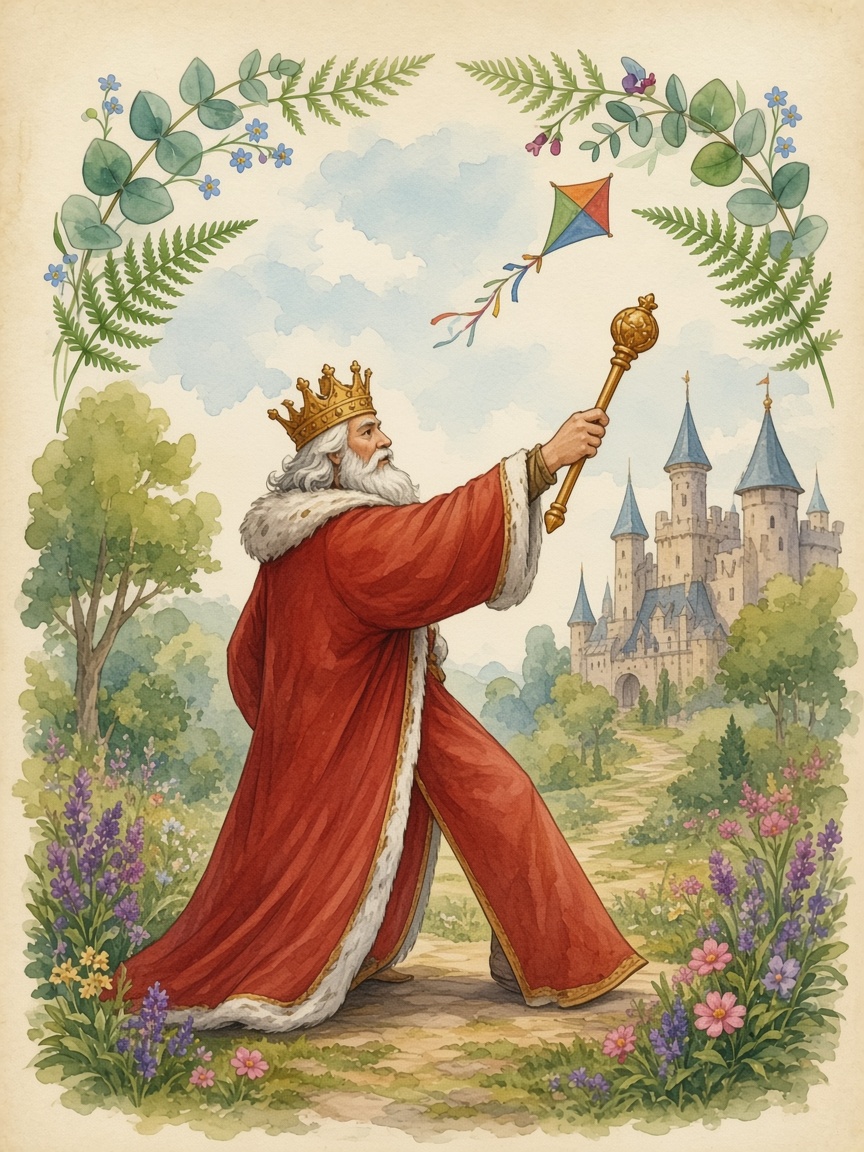
A kind king striding out with his scepter raised, his body making the letter K.

For ages 5–7, or whenever a child begins asking about letters.

Watercolor of the king forming the letter K

Aim

To let the child receive the letter K the Waldorf way: first a story, then a picture, and only then the letter, discovered hiding inside the picture like a secret.

The picture of the king carries both the shape of K and its sound, so the child meets the letter as a living friend rather than an empty mark.

By age

Littles (3–4): just the story and the picture. Do not point out the letter at all, it will be waiting for them in a year or two.

Olders (5–7): the full sequence: story, drawing, finding the letter, walking its shape, and writing it large.

Materials

  • Beeswax crayons or thick colored pencils
  • Large unlined paper
  • A tray of sand, salt, or cornmeal for finger-writing
  • Watercolors for the story picture

Opening Verse

King so kind and king so tall,
Kicking out to greet us all,
Arm held up and leg held out,
K is what a king's about.

The Story

The King Who Kicked the Kite Free.

There once lived an old king who was known in all the land for his kindness. Every day he walked in the castle garden and talked with the gardeners, the cooks, and the children.

One windy morning a little girl named Kate was flying her kite near the castle. Up it went, higher and higher, until it caught fast in the branches of a tall tree.

Kate began to cry. The king heard her and came striding over in his long red robe. He stood very straight, raised his scepter high at an angle to reach the branch, and kicked one leg forward to steady himself.

"K!" went the scepter as it knocked the branch, a quick hard click. The kite came loose, and the wind carried it up into the blue sky again.

Kate laughed and thanked him. And from then on, whenever the children of the kingdom played at being the king, they stood up straight, threw one arm up and kicked one leg out, and called it the K.

The Discovery

The day after the story, draw the picture together, big and beautiful, and then the magic: trace the picture slowly with your finger and say, Look, there is a letter hiding in our picture!

Let the child find the K shape inside the drawing themselves if they can. A letter a child discovers belongs to them forever.

The king IS the letter when drawn side-on: his straight body is the tall line, the raised scepter reaches up and out, and his forward leg kicks down and out. Both diagonals meet at his middle.

Movement

Walk the letter: lay a rope or ribbon on the floor in the shape of a great K and walk it heel-to-toe, both directions, saying its sound.

Then write it in the air with a whole arm, in the sand tray with one finger, and on each other’s backs to guess.

Writing Work

Now the crayon: write the K very large on unlined paper, once beautifully is worth more than a row of twenty. Then write the small k beside it, its little sibling. Then the child hunts the letter like a hidden bird: king, kite, kind, kettle, kitten, key, kick, kangaroo. How many K-friends can you find in one day?

End by hanging the story picture with its letter on the wall. The alphabet grows along the wall through the year, picture by picture.

Spiritual Meaning

For the parent:

Humanity drew pictures long before it wrote letters, and every child recapitulates that journey. Meeting letters through images honors the way the young mind actually works: whole, pictorial, and story-shaped first.

For the child, keep it simple:

K is a quick and clear sound, a click like a key turning. It belongs to someone who reaches out to help.

Closing Verse

Thank you, king, so kind and tall,
Kite set free above the wall,
Arm held up and leg kicked out,
K, I know what you're about.

Extension Ideas

  • Find the K on signs and packages all week, greet it like a friend.
  • Model the letter in beeswax or bread dough.
  • Tell the story again at bedtime and let the child finish the sentences.
  • Move to the next letter only when this one is loved: one letter a week is plenty.
  • See all the letters together in ABCs: Letters & Sounds.

Parent Note

Consonants come first in Waldorf letter work because they are picture-like; vowels come later as feelings and sounds. And there is no race: a letter met deeply at six outruns twenty-six memorized anxiously at four.