Letters Through Stories · P

The Letter P: The Pennant

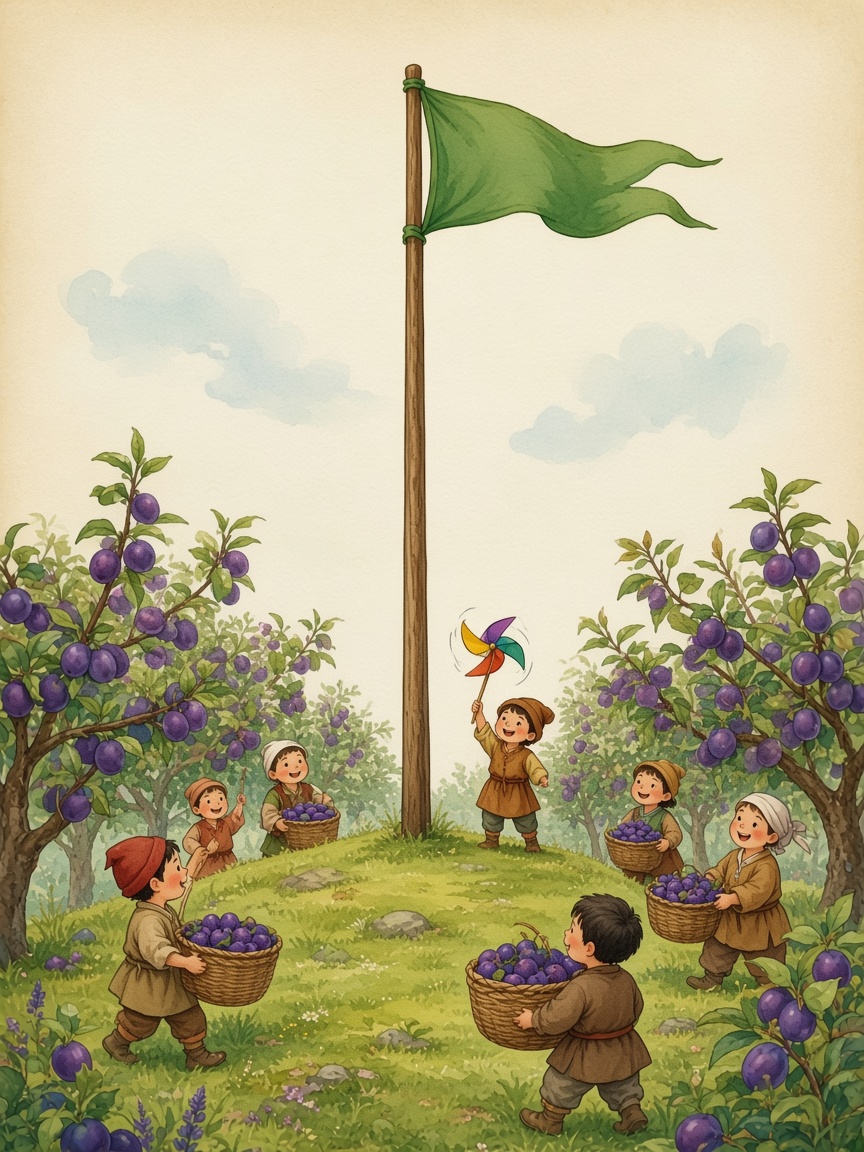
A pennant fluttering from a tall pole on the hilltop, the letter P flying in the breeze.

For ages 5–7, or whenever a child begins asking about letters.

Watercolor of the pennant forming the letter P

Aim

To let the child receive the letter P the Waldorf way: first a story, then a picture, and only then the letter, discovered hiding inside the picture like a secret.

The picture of the pennant carries both the shape of P and its sound, so the child meets the letter as a living friend rather than an empty mark.

By age

Littles (3–4): just the story and the picture. Do not point out the letter at all, it will be waiting for them in a year or two.

Olders (5–7): the full sequence: story, drawing, finding the letter, walking its shape, and writing it large.

Materials

  • Beeswax crayons or thick colored pencils
  • Large unlined paper
  • A tray of sand, salt, or cornmeal for finger-writing
  • Watercolors for the story picture

Opening Verse

Pole so tall upon the hill,
Pennant puffing, never still,
Straight pole down and flag up high,
P is flying in the sky.

The Story

The Pennant on Plum Hill.

On top of Plum Hill there stood a tall wooden pole, and from its top flew a pennant that the village children had sewn together from green cloth.

When the pennant flew, it meant the plums were ripe and everyone could come and pick. A little boy named Peter was given the job of raising it each summer.

One morning Peter climbed the hill with the pennant tucked under his arm and his pinwheel in his hand. He tied the pennant to the very top of the pole and pulled it up. "P, p, p," puffed the wind as it caught the cloth.

The pennant filled out into a round shape at the top of the pole and flapped there proudly. Down in the village the people saw it and said, "The plums are ready!" and they came up the hill with their baskets.

Peter's pinwheel spun, the pennant puffed, and everyone ate purple plums all afternoon. When they looked up at the pole, tall and straight with its round flag at the top, they saw the shape of P.

The Discovery

The day after the story, draw the picture together, big and beautiful, and then the magic: trace the picture slowly with your finger and say, Look, there is a letter hiding in our picture!

Let the child find the P shape inside the drawing themselves if they can. A letter a child discovers belongs to them forever.

The pole and pennant ARE the letter: the straight pole going all the way down and the round flag puffed out at the very top. Compare it with B, the bear has two rounds, and the pennant only one.

Movement

Walk the letter: lay a rope or ribbon on the floor in the shape of a great P and walk it heel-to-toe, both directions, saying its sound.

Then write it in the air with a whole arm, in the sand tray with one finger, and on each other’s backs to guess.

Writing Work

Now the crayon: write the P very large on unlined paper, once beautifully is worth more than a row of twenty. Then write the small p beside it, its little sibling. Then the child hunts the letter like a hidden bird: plum, pole, pennant, pinwheel, pig, puff, pear, path. How many P-friends can you find in one day?

End by hanging the story picture with its letter on the wall. The alphabet grows along the wall through the year, picture by picture.

Spiritual Meaning

For the parent:

Humanity drew pictures long before it wrote letters, and every child recapitulates that journey. Meeting letters through images honors the way the young mind actually works: whole, pictorial, and story-shaped first.

For the child, keep it simple:

P is the little puff of breath. Hold a feather in front of your lips and say it: the feather moves.

Closing Verse

Pennant puffing, pole so tall,
Purple plums for one and all,
P, p, p, the breezes blow,
P is flying, now I know.

Extension Ideas

  • Find the P on signs and packages all week, greet it like a friend.
  • Model the letter in beeswax or bread dough.
  • Tell the story again at bedtime and let the child finish the sentences.
  • Move to the next letter only when this one is loved: one letter a week is plenty.
  • See all the letters together in ABCs: Letters & Sounds.

Parent Note

Consonants come first in Waldorf letter work because they are picture-like; vowels come later as feelings and sounds. And there is no race: a letter met deeply at six outruns twenty-six memorized anxiously at four.