Letters Through Stories · N

The Letter N: The Narrow Bridge

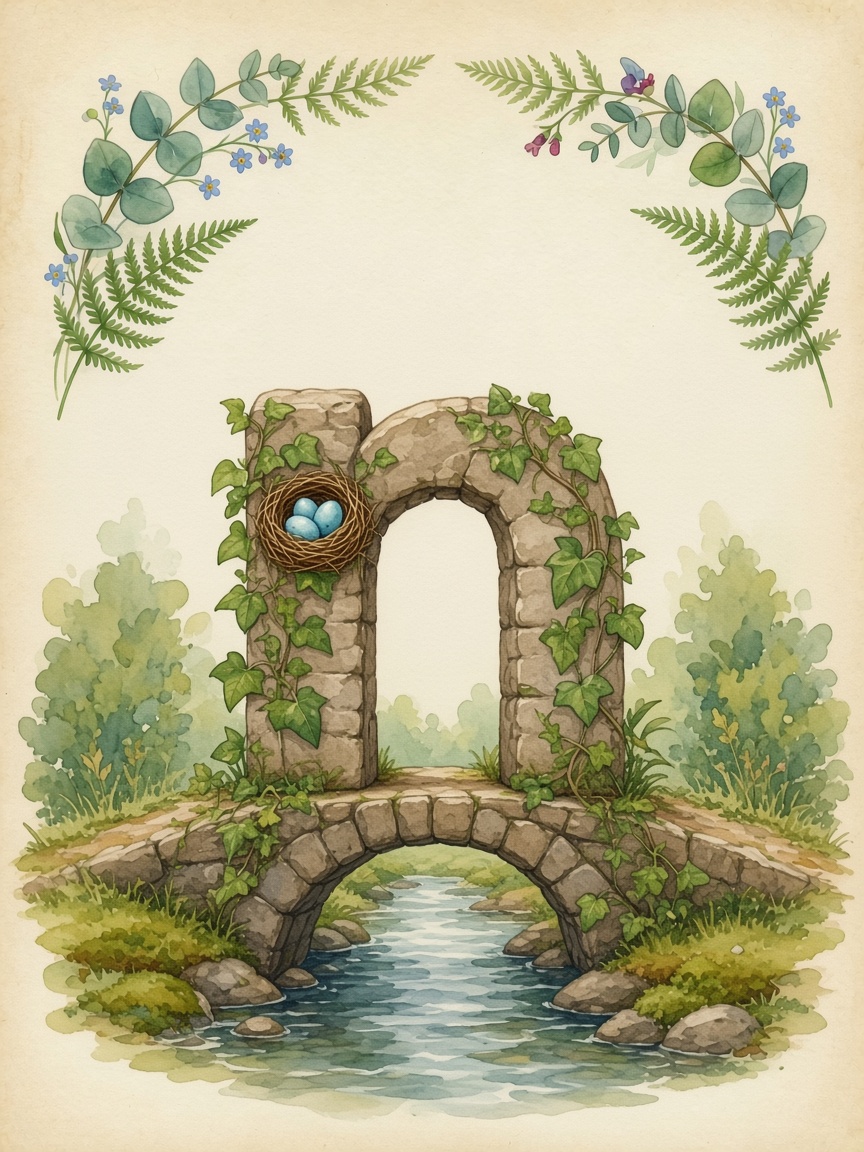
An old arched footbridge over the brook, with a nest tucked in the ivy, the letter n.

For ages 5–7, or whenever a child begins asking about letters.

Watercolor of the narrow bridge forming the letter N

Aim

To let the child receive the letter N the Waldorf way: first a story, then a picture, and only then the letter, discovered hiding inside the picture like a secret.

The picture of the narrow bridge carries both the shape of N and its sound, so the child meets the letter as a living friend rather than an empty mark.

By age

Littles (3–4): just the story and the picture. Do not point out the letter at all, it will be waiting for them in a year or two.

Olders (5–7): the full sequence: story, drawing, finding the letter, walking its shape, and writing it large.

Materials

  • Beeswax crayons or thick colored pencils
  • Large unlined paper
  • A tray of sand, salt, or cornmeal for finger-writing
  • Watercolors for the story picture

Opening Verse

Narrow bridge across the brook,
Nest of eggs in ivy nook,
Up the post and over round,
n is the arch above the ground.

The Story

The Nest on the Narrow Bridge.

Over a little brook there stood an old stone footbridge, so narrow that only one person could cross at a time. It had one straight post on the near bank and a single round arch curving over to the far side.

One spring a little brown bird came looking for somewhere safe to build her nest. "Not in the meadow," she said, "the cows will tread on it. Not in the reeds, the water will rise."

At last she came to the narrow bridge. Ivy grew thick over the stones, and right at the top of the straight post there was a little nook. "Nnn," hummed the bird happily, "this is the place."

She built her nest and laid three blue eggs. Every day the children crossed the narrow bridge on their way to school, quietly, nose to toes, so as not to frighten her. "Nnn," she hummed to them as they passed.

When the eggs hatched, the children cheered, and the baby birds learned to fly in loops over the arch of the bridge. Up the post and over the arch, up and over, the same shape every time: n.

The Discovery

The day after the story, draw the picture together, big and beautiful, and then the magic: trace the picture slowly with your finger and say, Look, there is a letter hiding in our picture!

Let the child find the N shape inside the drawing themselves if they can. A letter a child discovers belongs to them forever.

The bridge IS the small letter n: straight up the post, then one round arch curving over and down. Note that M has two humps like two mountains and n has only one, like a single bridge.

Movement

Walk the letter: lay a rope or ribbon on the floor in the shape of a great N and walk it heel-to-toe, both directions, saying its sound.

Then write it in the air with a whole arm, in the sand tray with one finger, and on each other’s backs to guess.

Writing Work

Now the crayon: write the N very large on unlined paper, once beautifully is worth more than a row of twenty. Then write the small n beside it, its little sibling. Then the child hunts the letter like a hidden bird: nest, net, nut, nose, night, needle, nine, nap. How many N-friends can you find in one day?

End by hanging the story picture with its letter on the wall. The alphabet grows along the wall through the year, picture by picture.

Spiritual Meaning

For the parent:

Humanity drew pictures long before it wrote letters, and every child recapitulates that journey. Meeting letters through images honors the way the young mind actually works: whole, pictorial, and story-shaped first.

For the child, keep it simple:

N is the humming sound, nnn, made with the mouth closed. It is the sound of something content and safe.

Closing Verse

Narrow bridge, I cross with care,
Little nest is sleeping there,
Up and over, nnn I hum,
n, my friend, I'm glad you've come.

Extension Ideas

  • Find the N on signs and packages all week, greet it like a friend.
  • Model the letter in beeswax or bread dough.
  • Tell the story again at bedtime and let the child finish the sentences.
  • Move to the next letter only when this one is loved: one letter a week is plenty.
  • See all the letters together in ABCs: Letters & Sounds.

Parent Note

Consonants come first in Waldorf letter work because they are picture-like; vowels come later as feelings and sounds. And there is no race: a letter met deeply at six outruns twenty-six memorized anxiously at four.