Numbers Through Nature · 10

The Number Ten: Two Hands

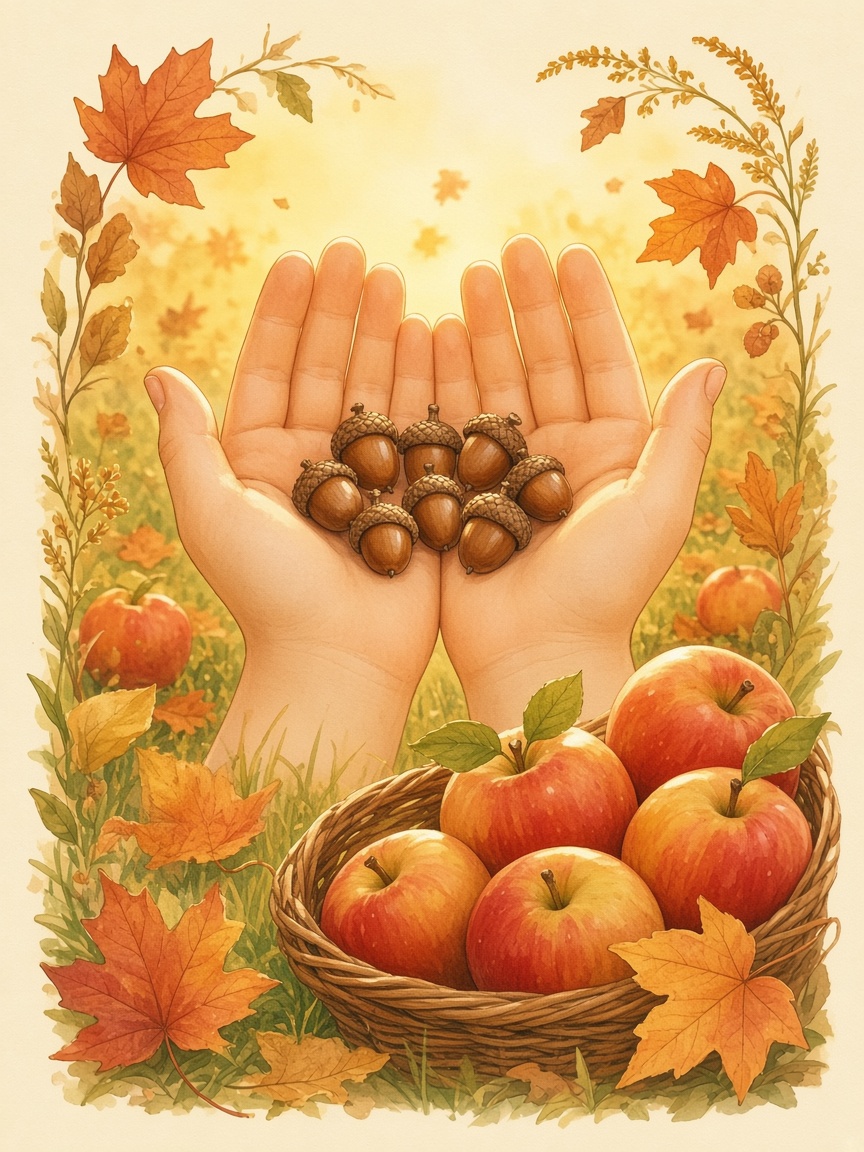
Two open hands and ten fingers, the first counting machine every child carries.

For ages 5–7. Numbers arrive as qualities first, quantities second.

Watercolor of two hands for the number ten

Aim

To let the child meet ten first as a quality living in the world, in two hands, before it ever becomes a numeral on a page.

When a number has a face and a story, counting becomes recognition rather than memorization.

By age

Littles (3–4): the story, the verse, and counting real things with touch. No numerals yet.

Olders (5–7): the full sequence: story, finding ten in the world, movement, and writing the numeral 10 large and beautiful.

Materials

  • Beeswax crayons
  • Large unlined paper
  • A basket of natural counters: acorns, stones, shells, or beans
  • Watercolors for the story picture

Opening Verse

Ten little fingers, two hands wide,
Five on this and five that side,
Hold the acorns, hold the sun,
Ten is two hands, all in one.

The Story

The Ten Acorns.

One autumn day a little girl went out into the garden with an empty basket and two empty hands. "I will gather acorns for the squirrels," she said, "enough for the whole winter."

She found one acorn under the oak and put it in her right hand. Then another, and another, until she had five, one for each finger of her right hand. Her right hand was full.

"Oh dear," she said, "my hand is full, but I want more." Then she remembered her left hand. She found six, seven, eight, nine, ten acorns, one for each finger of her left hand.

Now both hands were full, ten acorns in all, and she held them up to the sun. "Two hands," she said, "five and five make ten." She laid them carefully in a row on the stone wall.

The squirrels came down from the oak and took them one by one, chattering their thanks. And the girl went back to gather ten more, and ten more after that, counting each time on her ten fingers.

Finding It In The World

Count ten fingers and ten toes. Gather ten of something from the garden: acorns, pebbles, leaves, and lay them out as two rows of five.

Notice that ten is where counting starts over: after ten comes ten and one, ten and two. Bundle ten sticks with a ribbon to make one bundle of ten.

Movement

Clap ten times, stamp ten times, and jump ten times. Play finger games such as "Ten in the Bed." Hold up both hands and fold the fingers one by one, counting down from ten to one.

Writing Work

Paint or draw the story picture first. Then, on a fresh page, write the numeral 10 very large with a crayon, slowly, saying “ten” as you go. Beside it draw ten of something from the story.

Older children can also write the word TEN beneath, and lay out 10 counters in different arrangements to see how many ways ten can be made.

Spiritual Meaning

For the parent:

Ten is the completion of the first counting journey and the start of the next. It is no accident that we count in tens: our two hands are the oldest abacus, and through them the child feels number in their own body.

For the child, keep it simple:

Ten is two hands full. Five on one side and five on the other, all ten fingers ready to help.

Closing Verse

Ten little fingers, thank you, hands,
Helping in the garden lands,
Five and five and ten in all,
Hands for work and hands for ball.

Extension Ideas

  • Make bundles of ten sticks for place value work later.
  • Sing "Ten in the Bed" or "Ten Green Bottles."
  • Count backwards from ten for a rocket launch.
  • Trace both hands on paper and number the fingers one to ten.
  • Return to One, The Sun and count up through every number lesson in order.

Parent Note

Ten closes the first circle of numbers. Before moving on to arithmetic, let the child live in one to ten for a long time, with real objects and the body, until each number feels like a friend.