Numbers Through Nature · 6

The Number Six: The Honeycomb

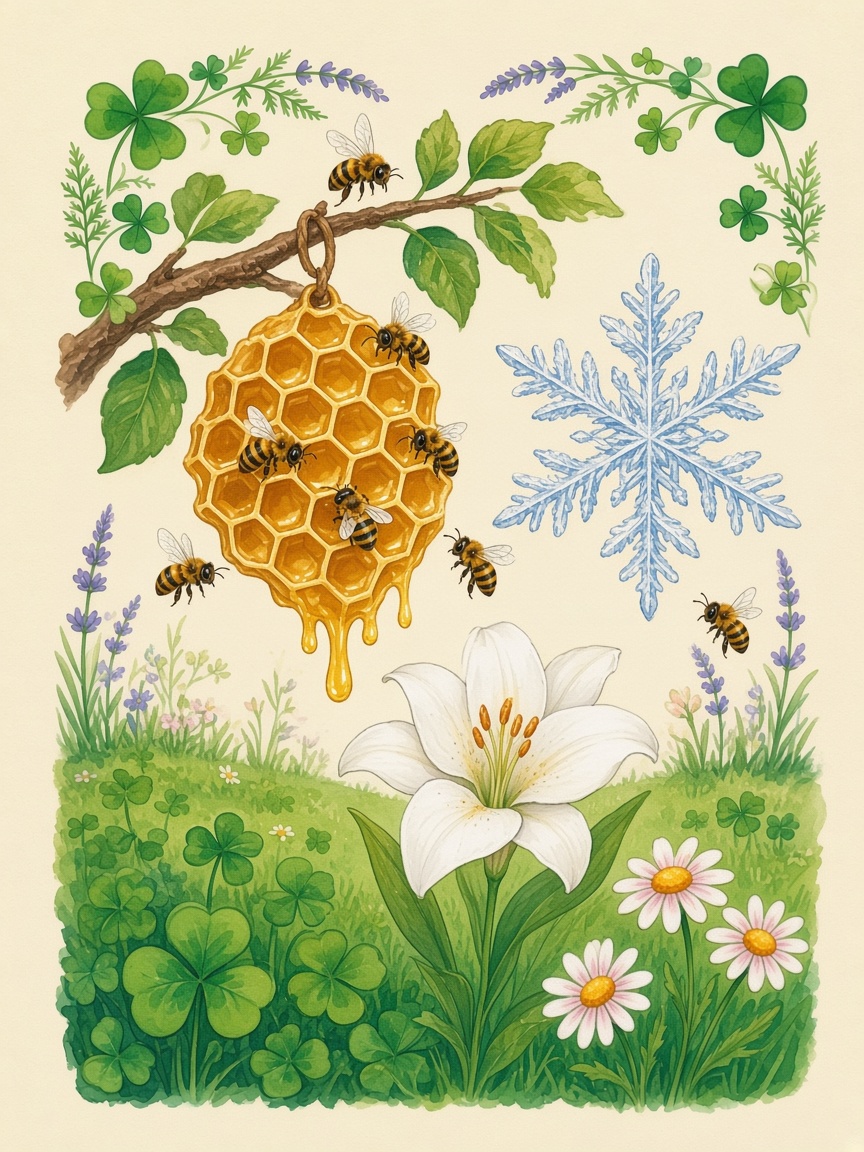
The six-sided cells of the honeycomb, the six arms of the snowflake, and the lily with six petals.

For ages 5–7. Numbers arrive as qualities first, quantities second.

Watercolor of the honeycomb for the number six

Aim

To let the child meet six first as a quality living in the world, in the honeycomb, before it ever becomes a numeral on a page.

When a number has a face and a story, counting becomes recognition rather than memorization.

By age

Littles (3–4): the story, the verse, and counting real things with touch. No numerals yet.

Olders (5–7): the full sequence: story, finding six in the world, movement, and writing the numeral 6 large and beautiful.

Materials

  • Beeswax crayons
  • Large unlined paper
  • A basket of natural counters: acorns, stones, shells, or beans
  • Watercolors for the story picture

Opening Verse

Six sides on the honeycomb,
Bees are building golden home,
Snowflake, lily, crystal bright,
Six is order, six is right.

The Story

The Bees Who Built a Golden House.

In the hollow of an old tree lived a family of honeybees, and they needed a place to keep their honey for the winter. "Let us build," said the queen, "but let us build well."

The first bee built a round room of wax. It was pretty, but when she built a second round room next to it, there were gaps in between where honey could leak away.

The second bee built a square room. That fit better, but the corners were weak and they sagged when the honey was poured in.

Then the youngest bee had an idea. She built a room with six sides, all the same, and then another beside it, and another, and they fit together perfectly with no gaps at all, strong and tidy as a quilt.

All summer the bees built six-sided rooms and filled them with golden honey. And when the first snow fell that winter, the youngest bee looked out and saw that every snowflake had six arms too. "The whole world knows how to build with six," she said.

Finding It In The World

Look closely at a piece of honeycomb (or a picture of one), and count the six sides of one cell. Catch snowflakes on a dark mitten in winter and count their six arms. Find lilies, tulips, and the inside of a cucumber, which often carry three or six.

Build with six: lay six coins or buttons around one in the middle and see how they fit perfectly, six around one.

Movement

Dance the honeycomb: six children (or six cushions) in a ring around one in the middle. Or walk a hexagon on the floor, six steps and six turns, buzzing as you go.

Writing Work

Paint or draw the story picture first. Then, on a fresh page, write the numeral 6 very large with a crayon, slowly, saying “six” as you go. Beside it draw six of something from the story.

Older children can also write the word SIX beneath, and lay out 6 counters in different arrangements to see how many ways six can be made.

Spiritual Meaning

For the parent:

Six appears wherever nature builds with order and economy: the hexagon tiles a surface with the least material, and water freezes into six-fold crystals. For the child it is a number of harmony, things fitting together exactly as they should.

For the child, keep it simple:

Six is the bees' number. They build their golden house in six-sided rooms, and the snowflake has six arms too.

Closing Verse

Six-sided rooms of golden wax,
Snowflakes falling on our tracks,
Thank you, bees, for building true,
Six fits together, me and you.

Extension Ideas

  • Draw a hexagon with a compass and six arcs (for olders), or with six sticks laid on the table.
  • Cut paper snowflakes folded into six.
  • Taste honey from the comb if you can find it.
  • Count by twos up to six, then by threes up to six.
  • Return to One, The Sun and count up through every number lesson in order.

Parent Note

Six is often the first number children can see as two threes or three twos. Let them discover the parts, but always begin with the whole honeycomb.