Numbers Through Nature · 8

The Number Eight: The Spider

The garden spider and her eight legs, the dewy web at sunrise, and the number that goes round and round.

For ages 5–7. Numbers arrive as qualities first, quantities second.

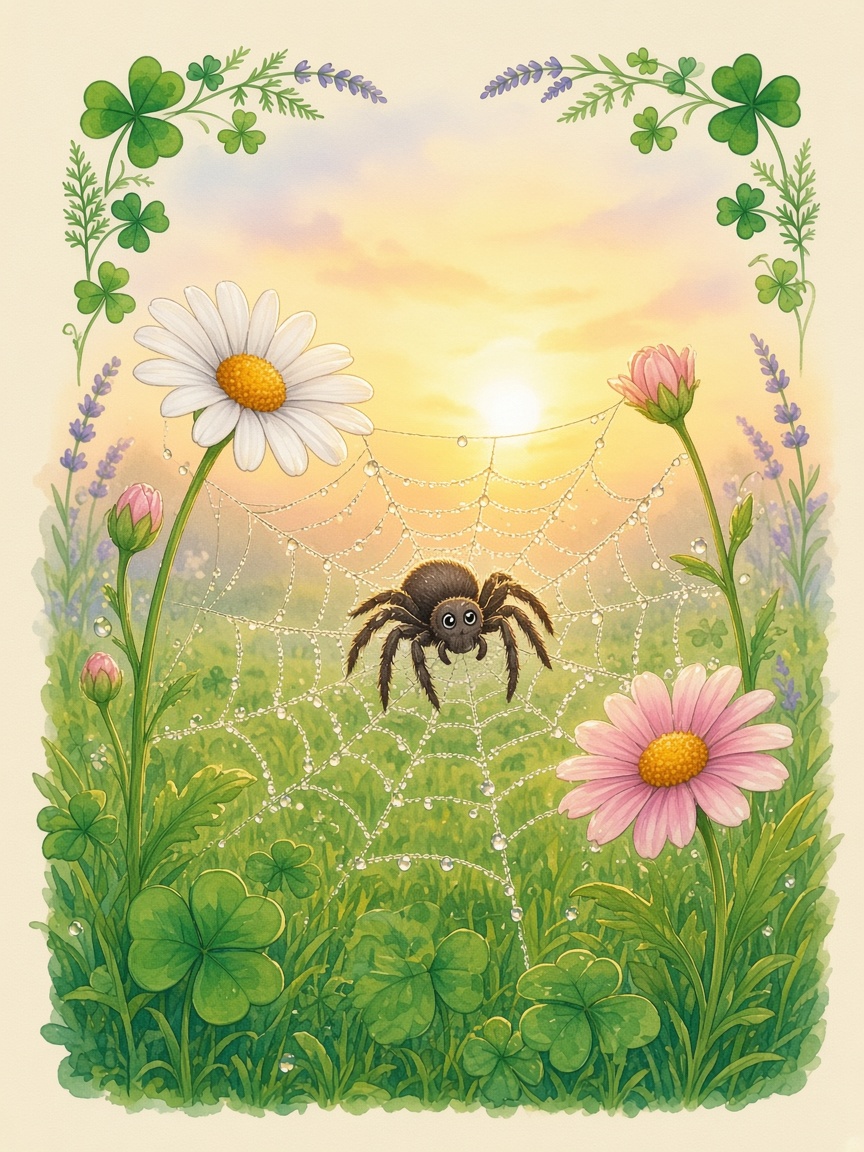
Watercolor of the spider for the number eight

Aim

To let the child meet eight first as a quality living in the world, in the spider, before it ever becomes a numeral on a page.

When a number has a face and a story, counting becomes recognition rather than memorization.

By age

Littles (3–4): the story, the verse, and counting real things with touch. No numerals yet.

Olders (5–7): the full sequence: story, finding eight in the world, movement, and writing the numeral 8 large and beautiful.

Materials

  • Beeswax crayons
  • Large unlined paper
  • A basket of natural counters: acorns, stones, shells, or beans
  • Watercolors for the story picture

Opening Verse

Spider spinning in the dew,
Eight legs working, strong and true,
Round and round the web she weaves,
Eight between the flower leaves.

The Story

The Spider Who Spun at Dawn.

In a summer meadow, between a daisy and a clover, lived a little garden spider named Octavia. She had eight long legs, and each morning before the sun rose she spun a brand new web.

First she spun the threads that went out like the spokes of a wheel. Then she walked round and round, from the outside in, laying down a spiral of silk, using all eight legs to measure and pull and tie.

One morning a caterpillar watched her working. "How do you do it so quickly?" he asked. "With eight legs," said Octavia, "four on each side. Two and two and two and two, they all work together."

"I have many more legs than you," said the caterpillar, "but I cannot spin a web." "No," laughed Octavia, "but one day you will have wings, and I never will. Each of us has our gift."

Just then the sun rose, and the dew on the web lit up like a necklace of jewels. Octavia sat in the middle of her shining web, eight legs out, and the whole meadow seemed to sparkle.

Finding It In The World

Count the legs of a spider (gently, from a distance, or in a picture): four on each side, eight in all. Look for octopus pictures with eight arms.

Draw the number eight as two circles stacked, or walk it as a figure eight that goes round and round without ending, like the spider's spiral.

Movement

Walk or run a figure eight around two chairs or two trees, again and again without stopping. Then make a spider with your hands: link thumbs, and wiggle the eight fingers as the legs.

Writing Work

Paint or draw the story picture first. Then, on a fresh page, write the numeral 8 very large with a crayon, slowly, saying “eight” as you go. Beside it draw eight of something from the story.

Older children can also write the word EIGHT beneath, and lay out 8 counters in different arrangements to see how many ways eight can be made.

Spiritual Meaning

For the parent:

Eight is the first cube (two times two times two) and, laid on its side, the sign of the infinite. In the figure eight the child experiences a continuous loop that crosses itself and returns, a picture of rhythm and renewal.

For the child, keep it simple:

Eight is the spider's number. Four legs on each side, working together, and the figure eight goes round and round forever.

Closing Verse

Octavia, thank you for your thread,
Eight legs dancing, dew-light spread,
Round and round and never end,
Eight, my looping, spinning friend.

Extension Ideas

  • Make a spider web of yarn between the legs of an upturned chair.
  • Practice the figure eight with a ribbon on a stick.
  • Count by twos to eight: two, four, six, eight.
  • Tell the story of Anansi the spider.
  • Return to One, The Sun and count up through every number lesson in order.

Parent Note

Some children are afraid of spiders. Keep the picture gentle and friendly, and remember that a fear met through a beautiful story often softens into curiosity.